
Investment Potential in Early-Stage Artificial Intelligence
By Ben Wallace
CM Wealth Director of Investments
“AI will be the biggest thing in this decade." – Bill Gates
Artificial Intelligence (AI) has emerged as one of the most transformative technological advancements of our era, reshaping industries, driving innovation, and opening a plethora of investment opportunities. CM Wealth has exposure to AI through public stocks such as Nvidia, venture-backed private companies, and direct investments that target long-term growth in data centers. For this reason, it’s important to know how AI is creating a dynamic landscape for investors and what we’re seeing in AI-related investment opportunities.
The Current State of AI
AI is not a new concept—its roots trace back to ancient history. While recent advancements in AI have garnered significant attention (in particular OpenAI's GPT series of models released to the public in 2022), the term was coined back in 1956 at the Dartmouth Workshop, and there’s been a centuries-long history of creating machines or systems to mimic human intelligence.
Recent AI applications range from machine learning, where algorithms learn from data and improve over time, to natural language processing, where machines are enabled to understand and interact with human language, and computer vision, which enables machines to interpret visual information from images or videos. These capabilities have given rise to AI-driven systems that autonomously make decisions, solve complex problems, and even engage in tasks such as language translation, speech recognition, and autonomous driving.
Is AI a Dynamic Landscape for Investors?
As we journey deeper into the AI age, it becomes evident that AI is not just a technological marvel but also a remarkable avenue for investment opportunities, creating a dynamic landscape for investors in several ways:
Innovation Catalyst: Startups are utilizing AI to continuously push boundaries and create new products, services, and solutions that have potential to revolutionize markets.
Efficiency and Automation: AI enables efficiency gains and automation on a scale never seen before. Investors can target startups that offer AI-driven solutions for businesses looking to streamline operations, reduce costs, and enhance productivity.
Data-Driven Insights: AI companies can utilize tools and technologies that provide deep insights into market trends and consumer behavior, among other considerations, helping them make informed decisions.
Cross-Industry Applications: AI applications span industries such as healthcare, finance, manufacturing, and entertainment. This cross-sector diversity provides a wide range of investment opportunities and potential for diversification. McKinsey identified 63 generative AI use cases spanning 16 business functions that could deliver total value in the range of up to $6.1 trillion to $7.9 trillion. This is atop their $11-17 trillion estimate of the economic value generative AI intelligence and analytics could unlock.
Disruption Potential: AI startups often have potential to disrupt traditional business models and challenge established industry players. These investment opportunities can lead to significant outsized returns.
Understand the Opportunity Landscape
While the venture capital industry has seen a reset to more normal valuations and fundraising levels over the last 18+ months, AI-related startups have been the buzz of 2023. What may appear on the surface as “hype” has been characterized by many as the first inning of an evolution.
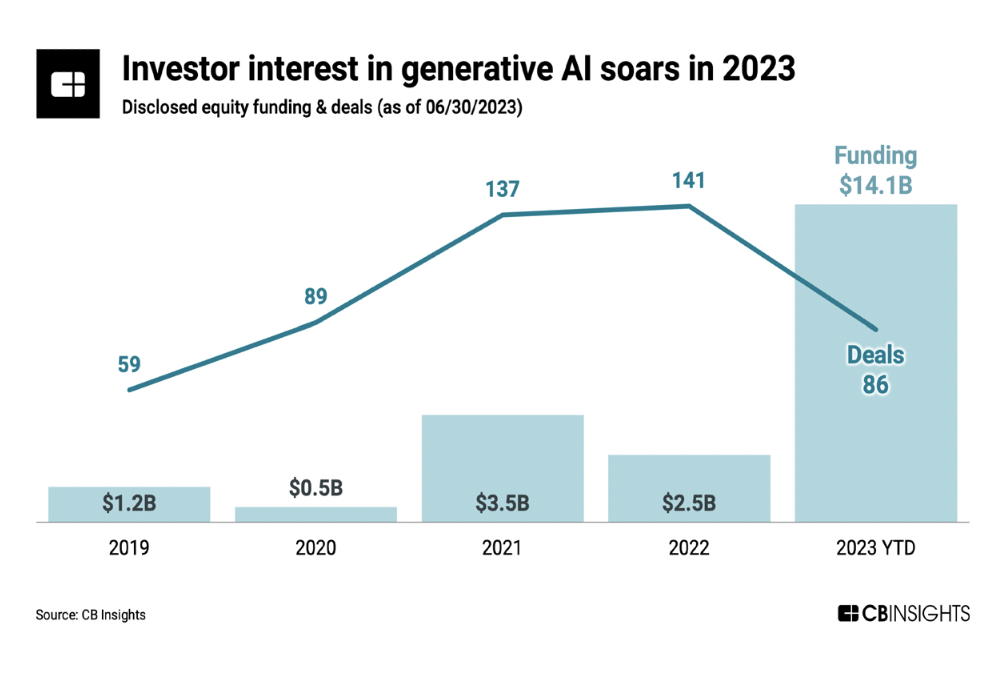
Investor Interest in Generative AI Reaches $14.1B in Early 2023
Generative AI takes a step further compared to machine and deep learning in that it creates data similar to its training data. This is in contrast to machine and deep learning which is primarily used to analyze data and make predictions.
The current generation of generative AI can create text outputs, images, music, and even computer code. Bloomberg Intelligence predicts that the generative AI market is poised to grow to $1.3 trillion over the next decade, up from a market size of just $40 billion in 2022, and that growth could expand at an annual rate of 42%.
Generative AI startups have raised a record $14.1 billion across 86 deals through the first half of 2023 and are on pace to raise over 11 times what was raised in 2022. In addition, AI companies founded by top AI talent from key AI players such as Alphabet, Microsoft, and Meta are seeing premium valuations for startups.
CM Wealth’s AI Investment to Date
Public companies Nvidia and Microsoft—stocks within our large-cap stock manager Edgewood—have repeatedly grabbed headlines in 2023 and seen their share prices increase substantially. While these companies are expected to see significant earnings growth over the next 5+ years, we anticipate these stocks to be more volatile as they appear “priced for perfection” on the surface.
Our greater focus is on our exposure in the private markets, particularly the venture capital segment, where companies are in their early days.
As noted above, AI companies with top talent from key players have grabbed premium valuations. Some of you may recall we highlighted Section 32 at our biennial Private Equity Meeting in 2019. Section 32, a venture capital firm, was founded by Bill Maris, the founder and first CEO of Google Ventures. The team today includes a number of former Google employees. Section 32’s roots from Google have created a significant sourcing advantage with the portfolios today including a number of companies traced back to Google. We invested in each of Section 32’s previous four funds in our 2017, 2019, 2021, and 2022 private equity funds, respectively.
AI is a recurring investment theme across Section 32 funds. For example, Cohere is a Section 32 Fund 3 portfolio company in our PE 2021 fund. This generative AI company, with an executive team that includes former senior Google business leaders and artificial intelligence experts, builds large language models (LLMs) for developers and enterprise customers and compete with the popular OpenAI platform.
Cohere raised two early rounds of funding in 2021 at valuations of $160 million and $800 million, respectively, and Section 32 participated in those rounds. The company recently raised a large Series C round at a $1.85 billion valuation, representing early 7.1x and 2.0x markups, respectively, from earlier rounds of funding. While we’re excited about the early breakout and markup of Cohere we remain cautiously optimistic, as the space is still nascent.
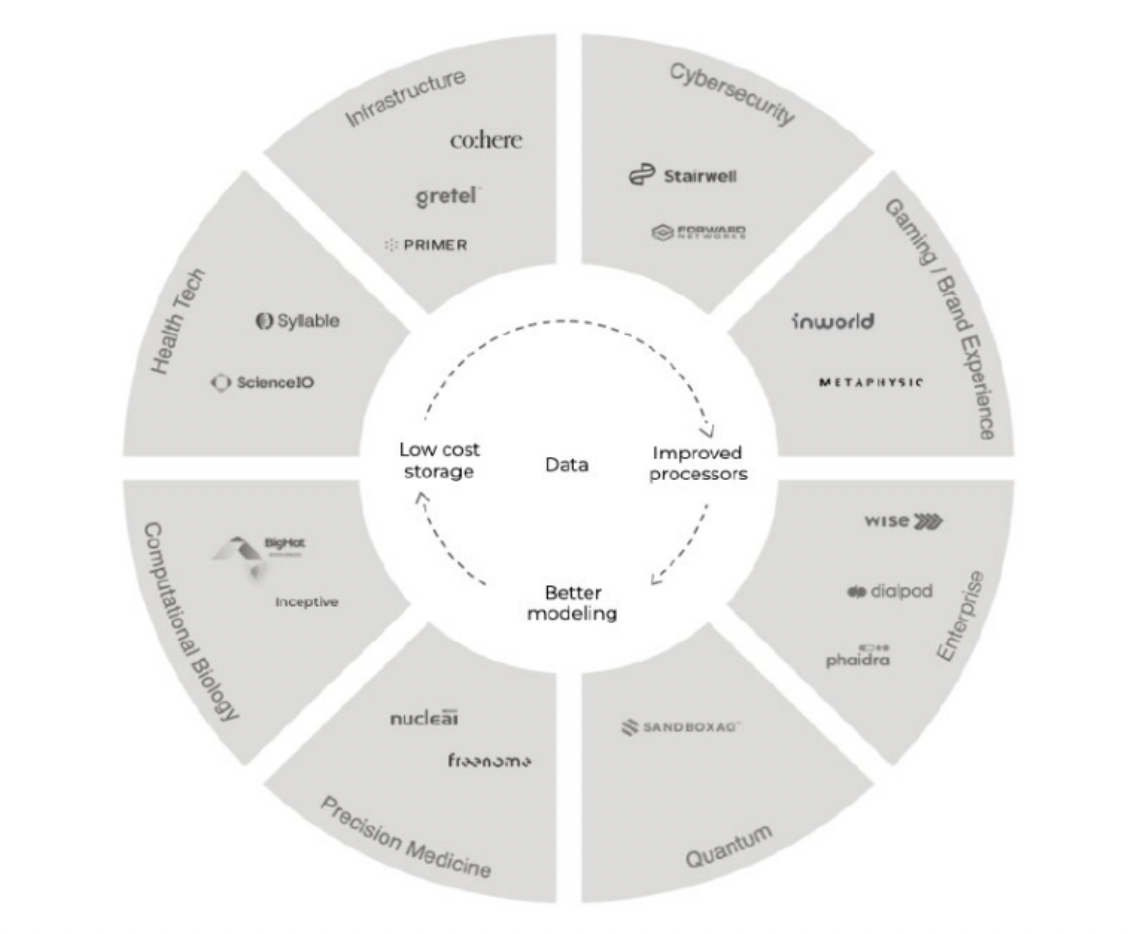
Section 32 Portfolio Sample
Other Section 32 examples, shown in the figure to the right, include Inceptive (Fund 4), co-founded by authors of the 2017 Transformer paper; Exai Bio (Fund 4) and BigHat Biosciences (Fund 4), co-founded by former leaders of Google Genomics and Google Brain; and Phaidra (Fund 2), co-founded by a senior researcher from Google Deepmind, among many others.
Like Section 32, many of our venture capital fund investments are focusing on AI. Pioneer Square, a Seattle-based early-stage VC fund which we’ve invested with across multiple funds, has made a number of early-stage investments, with several founders coming from Microsoft and Amazon. Its last three fund investments were in AI companies—an AI copilot for cybersecurity operations, an AI platform for military offroad ground vehicle autonomy, and a generative AI tutoring agent.
Primary Ventures, another CM Wealth relationship that dates back multiple funds, has made a number of AI-related investments, with their most recent in Etched, a designer of semiconductors for large language models (LLMs), the enabling technology at the heart of the Generative AI boom Unlike standard graphics processing units (GPUs), which are built for versatility, Etched exclusively runs LLMs, a sacrifice the team believes can make this chip 140x faster than current, best-in-class GPUs. The device is a fraction of the cost to manufacture and run compared to a GPU, offering companies with AI-centric products a more affordable, powerful, and efficient alternative.
We also have a more differentiated exposure to AI through data center-specific land acquisition. Long-term growth trends in data, AI, and internet traffic growth have caused large cloud service providers (“hyperscalers”), like Meta, Amazon, and Alphabet, to build infrastructure at an increasing rate.
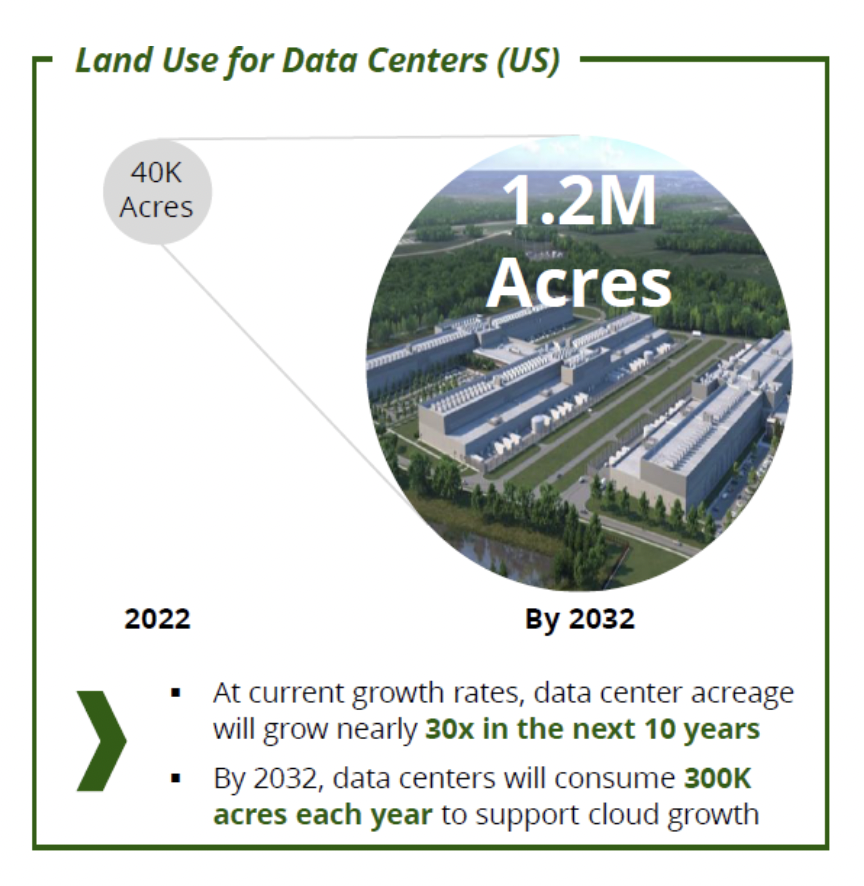
Data Center Acreage Projected to Grow 30x in 10 Years
Tract, for instance, is a co-investment in our Private Opportunities III fund alongside digital infrastructure, enterprise technology, and mobility specialist Columbia Capital.
Founded in 2022, Tract identifies and acquires viable data center land to create standardized, shovel-ready data center development sites married with in-place renewable solutions for hyperscale and wholesale providers within the United States.
The Tract team is a repeat Columbia Capital team that recently underwent a successful portfolio company exit in the data center space. The Tract team is underwriting 2-3x outcomes and is a great example of the type of less correlated, less volatile return we seek in our Private Opportunities funds.
A Promising Future for a Range of Beneficiaries
As we peer into the AI landscape, it’s clear we’re witnessing just the opening act of a profound technological revolution. Artificial intelligence, in its early innings, promises transformative advancements that will touch many facets of our lives. The potential beneficiaries of AI are broad, reaching across industries and demographics, offering a tantalizing glimpse into a future where innovation knows no bounds.
Yet, despite this promise, the performance of public market stocks behind AI may have appeared somewhat narrow thus far in 2023, driven by the “magnificent seven,” those behemoth stocks, like Amazon and Google, that have an outsized effect on the Nasdaq.
The journey has just begun, and the most remarkable chapters of AI's story are yet to be written, offering opportunities for those with foresight to invest in transformative technology. We are excited about the exposure we have to date for our clients as well as the AI-related opportunities our managers are executing on in real time.